
The Declaration of Independence Was a Process, Not a Single Day
Independence was approved on July 2, the Declaration’s text was adopted on July 4, and most delegates signed the parchment on August 2

Every July 4, Americans celebrate the adoption of the Declaration of Independence as the birth of the United States. The date appears prominently at the top of the document and has become inseparable from the national story.
The Declaration, however, was not debated, approved, written on parchment and signed by all 56 delegates during one dramatic meeting on July 4, 1776.
It emerged through a sequence of decisions extending across several weeks—and, in the case of the final signatures, several years.
Congress voted for independence on July 2. It approved the Declaration’s final language on July 4. The approved text was then printed and distributed. On July 19, Congress ordered an official parchment copy to be engrossed. Most delegates signed that parchment on August 2, while several others added their names later.
Understanding this chronology does not diminish July 4. Instead, it reveals how the United States moved from a political decision to a public declaration and then to a signed national covenant.
July 2: Congress declares independence
The decisive legal and political break occurred on July 2, 1776, when the Continental Congress approved Richard Henry Lee’s resolution declaring the colonies free and independent states.
Lee had introduced the resolution in June. Its central proposition was that the colonies no longer owed allegiance to the British Crown and that the political connection between them and Great Britain should be dissolved.
While Congress considered independence, it appointed a Committee of Five—Thomas Jefferson, John Adams, Benjamin Franklin, Roger Sherman and Robert R. Livingston—to prepare a statement explaining the decision.
Jefferson produced the initial draft. Adams and Franklin reviewed it, and the committee submitted it to Congress. Delegates then debated and revised the document, removing or modifying substantial portions before approving its final language.
John Adams believed July 2 would become the great American anniversary. In a letter to his wife, Abigail, he predicted that future generations would commemorate the date with ceremonies, games, bells, bonfires and illuminations.
His prediction about the celebration was remarkably accurate. He was simply two days early.
July 4: The text is approved
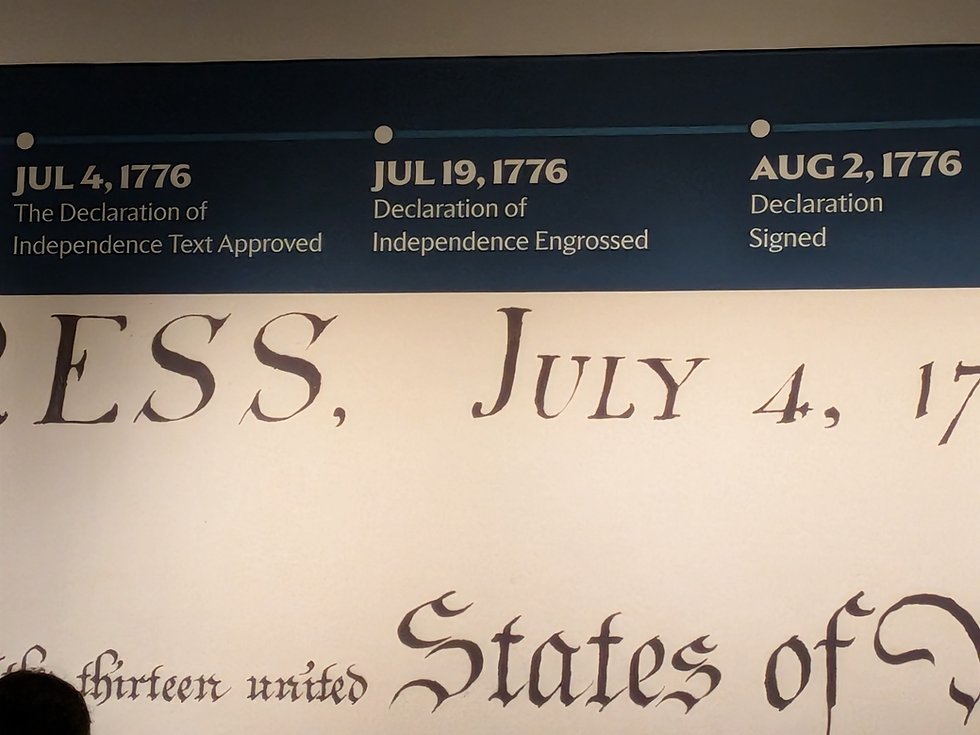
On July 4, Congress completed its revisions and formally adopted the Declaration’s text. This is the date printed on the document and the date the United States commemorates as Independence Day.
The approved Declaration did more than announce separation. It explained why the colonies believed independence was justified, expressed a philosophy of natural rights and listed grievances against King George III.
That evening, printer John Dunlap began producing broadside copies of the approved text. These printed copies carried the names of Continental Congress President John Hancock and Secretary Charles Thomson, but not the complete collection of signatures familiar to Americans today.
The broadsides allowed the declaration to move beyond the walls of Congress. Copies were sent to colonial governments, committees and military commanders. The words were read publicly and reproduced in newspapers.
The Declaration therefore became public through printing before the famous signed parchment existed.
July 19: An official parchment is ordered
On July 19, Congress ordered that the Declaration be formally engrossed on parchment under the title “The unanimous Declaration of the thirteen united States of America.”
To engross a document meant to prepare an official handwritten copy in a clear and formal script. Timothy Matlack is generally credited with producing the parchment copy that is now preserved by the National Archives.
This explains why the handwriting known to generations of Americans is not Thomas Jefferson’s handwriting. Jefferson drafted the Declaration, but the iconic parchment was a carefully prepared official copy.
The July 19 order also directed that the engrossed document be signed by the members of Congress.
August 2: Most delegates sign
Most members signed the engrossed parchment on August 2, 1776—not July 4.
The signing transformed the previously approved and published words into a physical document bearing the names of the men who pledged their lives, fortunes and honor to the cause.
Even August 2 does not tell the entire story.
According to the National Archives, George Wythe signed on August 27. Richard Henry Lee, Elbridge Gerry and Oliver Wolcott signed on September 4. Matthew Thornton signed in November, and Thomas McKean may not have added his name until 1781.
Eventually, 56 delegates signed.
The familiar image of every signer gathered around the parchment on July 4 is therefore patriotic symbolism rather than a literal record of one meeting. Independence was a collective act, but its documentary history unfolded in stages.
The image most Americans recognize came later

There is another layer to the story: the clear, dark and highly legible Declaration reproduced in textbooks, classrooms and patriotic displays is usually not a direct image of the badly faded original parchment.
It is commonly an image derived from William J. Stone’s 1823 copperplate engraving.
By 1820, the original Declaration was already showing signs of deterioration. Secretary of State John Quincy Adams commissioned Stone to create a full-size facsimile preserving the text and signatures.
Stone spent approximately three years producing the copperplate. About 200 official copies were printed on parchment and distributed to surviving signers, government institutions, state and territorial officials and other recipients.
Stone’s engraving preserved a recognizable image of the Declaration before the original suffered further fading. It became the version most frequently reproduced in books, schools, libraries and public displays.
That distinction is important when identifying historical exhibits and reproductions. The Stone engraving is itself a major historical artifact, but it was created almost half a century after the Declaration was adopted.
The original parchment remains at the National Archives under carefully controlled preservation conditions.
Declared, published, signed and recognized
The creation of the Declaration can be understood through several important moments:
July 2, 1776: Congress approved independence.
July 4: Congress adopted the Declaration’s final text.
July 4–5: John Dunlap printed the first broadside copies.
July 19: Congress ordered an engrossed parchment copy.
August 2: Most delegates signed the parchment.
Later dates: Additional delegates added their names.
September 3, 1783: The Treaty of Paris brought British recognition of American independence.
Each date represents a different part of the founding process.
July 2 was the decision. July 4 was the explanation presented to the world. August 2 was the principal signing. The Treaty of Paris was international recognition that the United States had survived the war and secured its independence.
The Fourth of July remains the proper national anniversary because it commemorates the moment the United States publicly articulated the principles and grievances behind its separation.
But the complete story is richer than a single date.
American independence was debated, voted upon, written, revised, printed, proclaimed, engrossed, signed, defended in war and finally recognized by treaty.
Learn More
If you would like to learn more about the Declaration of Independence and how it was created, signed and preserved, additional information and historical records are available here:
Rebecca Canales is the founder and CEO of Whittier 360 News Network.


Comments