
Through the Rain: Beginning My America 250 Journey at the Washington Monument
Updated: Aug 29

Storm clouds obscured Washington as I began reporting on the Great American State Fair, offering an unexpected perspective on a nation entering its 250th year.
WASHINGTON, D.C. — I came to Washington to witness history.
My purpose was not simply to attend America's 250th anniversary celebrations as a visitor. I had come to observe, photograph and report for Whittier 360 News Network on the Great American State Fair and the events surrounding the nation's semiquincentennial.
On June 28, 2026, that journey began beneath storm clouds.
The Great American State Fair had opened on the National Mall three days earlier and was scheduled to run from June 25 through July 10, bringing together more than 150 exhibits representing the states and territories, businesses, innovators, museums, universities and civic organizations. June 28 itself had been designated Military & Veterans Appreciation Day.
But before I began walking among those exhibits, I went to the Washington Monument.
Washington was wet, gray and covered in low clouds. It was not the postcard image of the nation's capital that most visitors expect.
And as the morning unfolded, the weather began to seem strangely appropriate.

The enormous Freedom 250 flag hanging from the Department of Agriculture building left little doubt about the occasion. Washington was preparing to commemorate 250 years since the Declaration of Independence.
Yet the celebration was unfolding under a dark sky.
A Capital Under Rain
The weather that morning was not merely photographic atmosphere.
National Weather Service records show that Washington National Airport received 0.33 inches of rain on June 28. The temperature reached only 76 degrees—13 degrees below the normal daily high of 89.
Washington was also not alone in experiencing unsettled weather. That weekend the National Weather Service's Weather Prediction Center was tracking heavy-rain and flooding concerns in several regions of the country, including parts of the Ohio Valley, Tennessee Valley, North Carolina and Montana.
It was as though much of the country was entering the anniversary period under unsettled skies.

As I moved closer to the Washington Monument, its scale became increasingly apparent. From a distance it looks almost delicate—a narrow white line rising above Washington. From near its base, it becomes an enormous wall of stone disappearing upward toward the clouds.
There was also another way to understand the rain.
For many of the British colonists whose communities eventually became American states, weather was viewed through a strongly providential worldview. Rain could represent hardship when withheld, but mercy, relief and renewal when it finally came.
At Plymouth in 1623, for example, a prolonged drought threatened the colony's crops. After the colonists set aside a day of prayer, Edward Winslow described clouds gathering and producing what he called “soft, sweet, and moderate showers” that revived the crops. The community subsequently observed a day of thanksgiving.
The idea that hardship could be followed by providential relief was deeply familiar to the cultures from which the early American republic emerged.
The Continental Congress itself routinely interpreted national events through the language of Providence. In its 1777 Thanksgiving proclamation, issued while the Revolutionary War was still being fought, Congress referred to the “superintending providence of Almighty God” while giving thanks for blessings already received and praying for continued assistance in the struggle for independence.
That founding-era perspective offers one way of looking at rain: not necessarily as punishment or prediction, but as part of a cycle of hardship, endurance and possible renewal.

An American newspaper article preserved by the Library of Congress shows that the symbolism endured long after the founding generation.
Writing in Washington's Evening Star in 1934, Charles E. Tracewell reflected on rain following a prolonged hot, dry period. He described water sinking into parched soil and “bringing new life to roots” that had struggled to survive. He saw the gentle rain not as destruction, but as restoration—something that allowed life already present beneath the surface to recover.
Standing beneath the Washington Monument that morning, it was difficult not to think about that idea.
Rising Above the Storm
I entered the monument and took the elevator toward the observation level.

Going upward did not mean escaping the storm.
Instead, it gave me a different way to see it.
From the observation deck, Washington was visible in pieces. Familiar landmarks appeared through rain-covered windows while others nearly disappeared into the mist.
Looking south, the Thomas Jefferson Memorial remained recognizable across the Tidal Basin.

The monument was there.
The water was there.
The city was there.
But the farther I tried to look, the less certain the view became.
Looking west produced another rain-obscured view across some of the most symbolically important ground in the United States.
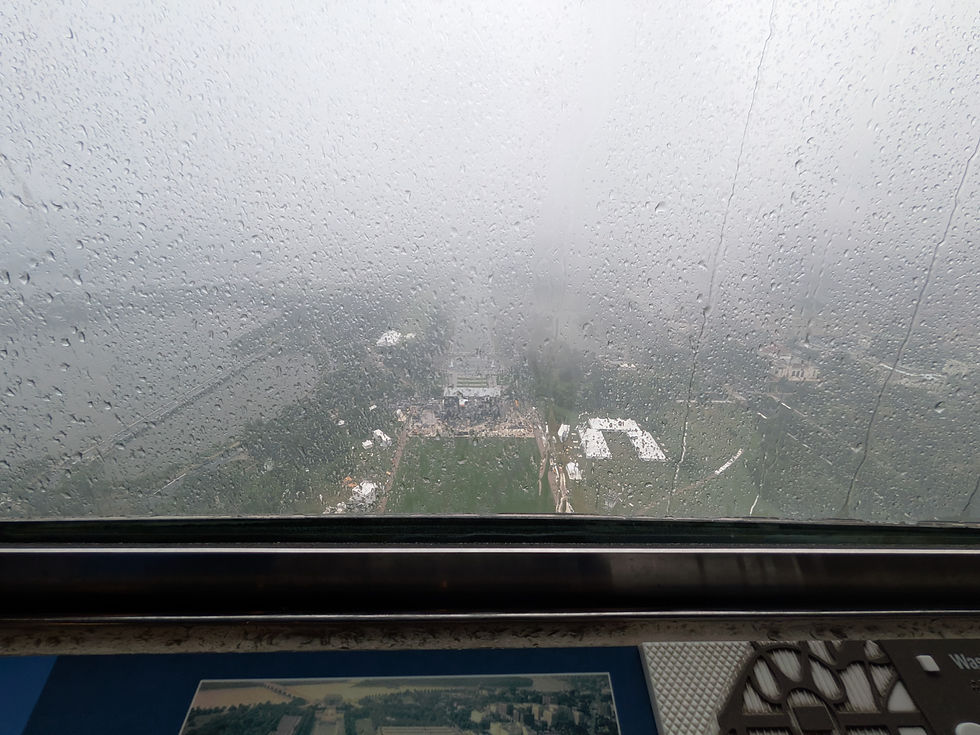
Below me were the grounds of the Great American State Fair—the reason I had traveled to Washington to report.
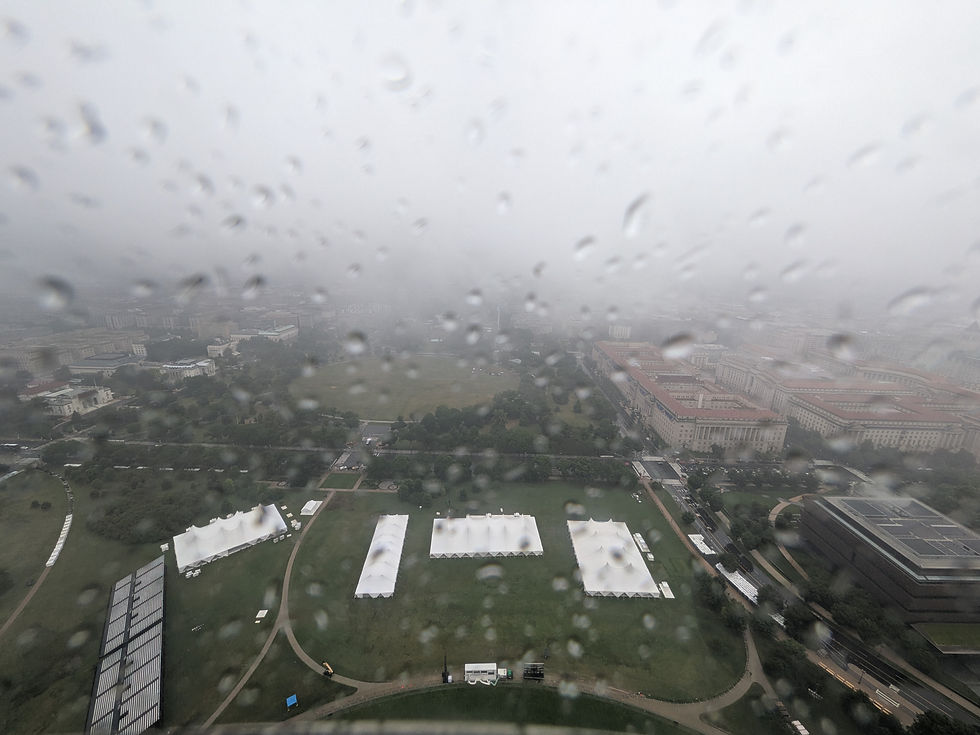
From street level, tents, stages and exhibition areas could seem like individual pieces spread across the enormous National Mall.
From hundreds of feet above them, they became part of a much larger picture.
That, too, seemed fitting for an anniversary intended to look back on 250 years of American history.
Our view of events changes depending upon where we stand.
Looking Through the Storm

Looking north brought another recognizable symbol into view: the White House.

It was from the observation deck that the storm began to take on another meaning for me.
America was approaching its 250th birthday during another period of intense political disagreement.
That is hardly unprecedented.
The nation has passed through storms far more severe than the disputes of the present day: revolution, civil war, economic depression, world wars, political violence, struggles over civil rights, Watergate, terrorist attacks and a global pandemic.
Those events were not equivalent in their causes, moral stakes or human costs. But each placed enormous pressure on American institutions and on Americans' faith in one another.
The current moment has its own disputes.
Immigration is one.
The Trump administration and its supporters argue that strong border enforcement and immigration enforcement are fundamental responsibilities of a sovereign nation and necessary to restore the rule of law. In June, President Donald Trump signed legislation providing $70 billion for Immigration and Customs Enforcement and Border Patrol through the remainder of his administration after a closely divided Congress approved the measure. The administration says expanded enforcement protects border security, communities and the integrity of the immigration system.
Opponents do not necessarily dispute that immigration laws should exist or that borders should be controlled. Their objections frequently center on how the government enforces those laws—raising concerns about due process, wrongful detention, family separation, civil liberties and the treatment of immigrants who have longstanding connections to American communities. Those disagreements have produced lawsuits, protests and disputes between federal, state and local authorities.
Election law presents another storm.
Supporters of the SAVE America Act argue that proof of citizenship and voter identification requirements would strengthen election integrity, ensure that only eligible citizens participate in federal elections and rebuild public confidence. House Administration Committee Chairman Bryan Steil described the legislation as a way to ensure voters are citizens and are who they say they are.
Opponents agree that elections must be secure but warn that safeguards can become barriers if eligible citizens cannot realistically satisfy them. The proposed legislation requires documentary proof of citizenship for federal voter registration and includes an alternative process for applicants who cannot produce the standard documents.
Critics argue that citizens living in extreme poverty, people without ready access to passports or certified birth records, older Americans, people whose names have changed, and groups with a history of barriers to political participation can face disproportionate difficulties obtaining the required documents. The Brennan Center, which opposes the legislation, estimates that more than 21 million eligible citizens do not have ready access to the principal documents contemplated by the requirement. Reuters and the Associated Press have likewise reported concerns about the accessibility of the documentation rules even as supporters maintain they are necessary election safeguards.
At its core, this is one of the recurring tensions in a democratic republic: How do we make elections secure while also ensuring that every eligible citizen has a practical opportunity to participate?
People can sincerely disagree about where that balance should be drawn.
And sometimes they disagree very loudly.

This photograph may capture the idea better than anything I could write.
Looking east, I knew where the United States Capitol was.
I could see it.
But only barely.
There was rain between me and one of the principal institutions of American government.
The Capitol had not disappeared because my view of it was obscured.
The destination was still there even when the path toward it was difficult to see.
For me, that became a useful metaphor for the United States at 250.
Americans disagree over what their government is doing, what it should be doing, what should change and what must be preserved. They disagree over immigration, voting, executive authority, the courts, Congress, taxes, spending, who gets to be American, foreign policy and the meaning of rights themselves.
Sometimes the disagreement becomes so intense that each side begins to believe the other represents an existential threat to the country.
Yet disagreement is not foreign to the American system.
It helped create it.
The Founders Had Their Storms, Too
The men who gathered in Philadelphia in 1787 did not arrive with a common blueprint for the future.
The National Archives notes that there was initially little agreement about the form the new government should take. Delegates fought bitterly over representation, the power of large states versus small states, slavery, the authority of the national government and the structure of Congress.
They eventually reached compromises that made the Constitution possible.
Not all of those compromises deserve celebration.
Some compromises only delayed the inevitable. For example the compromise over slavery was a major factor in the Civil War. Recognizing the founders' ability to compromise does not require pretending every compromise was wise or just. They bought time for the nation to develop.
But other disagreements demonstrate something important about the political system they created.
Federalists and Anti-Federalists argued fiercely over whether the new national government would become too powerful. Opponents of the Constitution demanded explicit protections for individual rights. Several states ratified while calling for amendments, and that political struggle ultimately contributed to adoption of the Bill of Rights.
James Madison himself spoke during Virginia's ratification debate about the difficulty of creating a general government amid a “diversity of opinions, and interests.”
That diversity never disappeared.
Americans inherited it.
The constitutional system was not designed around the expectation that citizens would eventually agree about everything. It was designed because they would not.
That does not make political conflict harmless. Like storms, conflict can become destructive. Institutions can fail. Rights can be violated. Majorities can abuse power, and minorities can obstruct legitimate government. Political rhetoric can become dehumanizing. Compromise itself can sometimes preserve injustice rather than solve it.
But conflict can also produce correction, reform and renewal when people remain committed to a common constitutional framework.
The question is not whether America will experience storms.
It always has.
The question is what Americans do while they are passing through them.
What Comes After the Rain?
Eventually I moved away from the observation windows.
Inside the Washington Monument, the view changed from the capital outside to the structure itself.
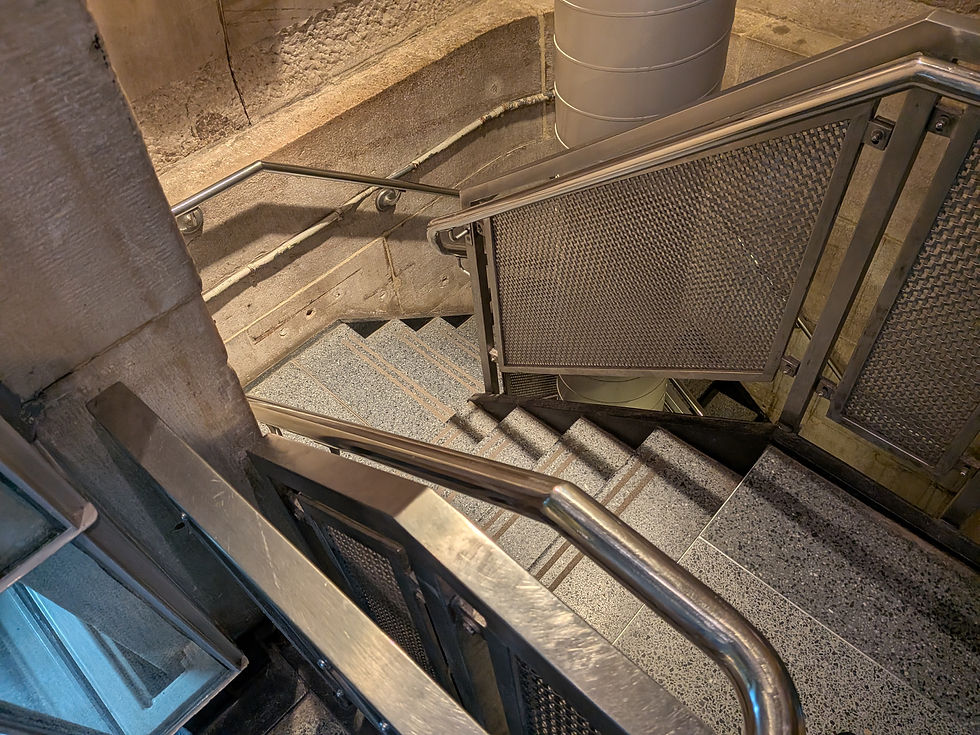
The monument is itself a product of interruption, disagreement and persistence.
Its construction stopped for years. Its design changed. Funding failed. Engineers encountered structural problems. Different generations inherited the unfinished work of those before them.
And yet it was completed.
Perhaps that is another useful way to think about national renewal.
Rain does not guarantee a good harvest. A storm can replenish the ground, but it can also cause destruction. What happens afterward depends on what survives and what people choose to cultivate.
That was part of what Tracewell wrote about in the 1934 Evening Star. Rain reached roots that had endured a long dry period and allowed something still alive beneath the soil to recover.
Maybe countries are not entirely different.
Public trust can become depleted. Institutions can become strained. Citizens can become exhausted with one another. Political arguments can harden into identities.
Renewal does not require forgetting those disagreements.
It requires finding some reason to continue the work despite them.
I cannot say that the rain falling on Washington on June 28 was a message from God about America's future.
Faith may lead some people to see it as a blessing. Others will see nothing more than weather passing over the capital.
But through the worldview familiar to many of the colonists and founding-era Americans who came before us, rain after hardship could represent mercy, sustenance and the possibility of new life.
And as a journalist standing inside the Washington Monument at the beginning of my America 250 coverage, I could not ignore the metaphor.
I had come to Washington to witness the country at 250—not to tell Americans what they were required to think about it.
What I found on that first morning was a nation preparing to celebrate while standing beneath storm clouds.
I saw the Jefferson Memorial through the rain.
I saw the White House through the rain.
I saw the Great American State Fair below.
And far down the National Mall, I could just make out the Capitol through the drops covering the glass.
The future was not visible from that window.
Neither is America's.
But uncertainty about what lies beyond the storm does not mean there is nothing beyond it.
Before leaving that part of the monument, another image offered an appropriate final thought.

Out of Many, One.
The words do not mean that Americans must become identical.
They do not mean that disagreement should disappear.
The people who established the country disagreed intensely with one another, just as Americans do now.
The challenge—then as now—is whether people with profoundly different beliefs can remain part of the same republic, protect one another's rights, maintain institutions strong enough to resolve disputes peacefully, and continue building something none of them could create alone.
America has weathered storms before.
At 250 years, it is weathering another.
What grows after the rain remains up to you and your fellow citizens of these United States.
Additional Photos in 360 Format


Comments