
The Treaty of Paris Recognized Thirteen Free, Sovereign and Independent States

The Declaration of Independence announced that the thirteen former colonies regarded themselves as free and independent states. The Treaty of Paris transformed that declaration into an international agreement recognized by Great Britain.
Signed on Sept. 3, 1783, the Treaty of Paris formally ended the American War for Independence. It did more than bring the fighting to a close. Its opening article acknowledged the political status the states had claimed since 1776.
The treaty declared:
“His Britannic Majesty acknowledges the said United States, viz. New Hampshire, Massachusetts Bay, Rhode Island and Providence Plantations, Connecticut, New York, New Jersey, Pennsylvania, Delaware, Maryland, Virginia, North Carolina, South Carolina and Georgia, to be free, sovereign and independent states.”
That language matters.
Britain did not simply recognize one consolidated country resembling the modern United States. The treaty individually named all thirteen states and recognized them as free, sovereign and independent states. King George III also relinquished British claims to their governments, territories and political authority.
From declared independence to recognized independence
Congress approved the Declaration of Independence on July 4, 1776, but Britain did not accept the states’ claim merely because Congress had announced it.
Independence had to be defended through war and ultimately recognized through diplomacy.
Preliminary peace articles were signed in Paris on Nov. 30, 1782. Those articles established the main terms of the settlement, but the definitive Treaty of Paris was not signed until Sept. 3, 1783.
The American commissioners were John Adams of Massachusetts, Benjamin Franklin of Pennsylvania and John Jay of New York. David Hartley represented Great Britain.
The treaty’s signature page bears their signatures and seals, recording the agreement that officially ended the conflict between Britain and its former colonies.
An alliance of independent states
The wording of the Treaty of Paris reflects the political organization that existed before the present Constitution.

At that time, the states were joined under the Articles of Confederation. Article II of the Confederation stated that each state retained its sovereignty, freedom and independence. Article III described their relationship as a “firm league of friendship.”
Congress conducted diplomacy and coordinated the common war effort, but the states retained substantial political authority and understood themselves as distinct sovereign communities.
The Treaty of Paris reflected that arrangement. It referred collectively to the United States while explicitly recognizing the thirteen named members as free, sovereign and independent states.
The word “united” described states acting together. It did not yet describe the more consolidated federal structure that began operating under the Constitution in 1789.
The boundaries of the new union
The treaty also established extensive boundaries for the states.
Britain recognized American territory stretching westward to the Mississippi River, north toward British Canada and south toward Spanish Florida. These boundaries gave the new confederation access to an enormous territory beyond the Appalachian Mountains.
The agreement also addressed fishing rights, debts owed to British creditors, property confiscated from Loyalists and the withdrawal of British forces.
Some of these provisions remained difficult to enforce. Congress could recommend that the individual states restore confiscated Loyalist property, but it could not simply command state legislatures to comply. Britain, meanwhile, continued occupying several western military posts after the treaty was signed.
These disputes exposed weaknesses in the government operating under the Articles of Confederation and contributed to later arguments for a stronger federal system.
Independence did not settle every question
The Treaty of Paris recognized the independence of the states, but it did not resolve the future of everyone living within the newly recognized boundaries.
Native nations were not parties to the treaty, even though the agreement transferred British territorial claims involving lands inhabited and governed by Indigenous peoples.
Thousands of Loyalists left the states or faced disputes over confiscated property. Enslaved people who sought freedom with the British confronted an uncertain future, while slavery remained legal throughout much of the new country.
The treaty ended one political conflict, but it did not settle the deeper struggles over territory, citizenship, sovereignty, slavery or the distribution of political power.

From a confederation to the Constitution
The peace settlement left thirteen sovereign states facing a new challenge: maintaining their independence while governing their shared territory and relationships.
Under the Articles of Confederation, Congress lacked independent taxing authority and depended heavily on cooperation from the states. Disagreements over commerce, debts and treaty enforcement demonstrated the limitations of the existing arrangement.
Four years after the Treaty of Paris was signed, delegates assembled in Philadelphia and drafted the Constitution. That document proposed a fundamentally stronger federal government operating directly upon individuals as well as states.
The Constitution was proposed in 1787, secured sufficient ratification in 1788 and entered operation in 1789.
The modern federal nation developed from that later constitutional transformation. The Treaty of Paris belongs to the earlier period, when the states had won recognition as free, sovereign and independent political communities joined together in a common union.
The words preserved on the page
The original Treaty of Paris offers more than the familiar conclusion that America won its independence.
Its precise language preserves how the victorious Americans and the British government understood the settlement in 1783.
The thirteen states had fought together, negotiated together and secured peace together. But the treaty still named and recognized them as states—plural.
That distinction helps explain the political debates that followed the Revolution. Americans had achieved independence from Britain, but they had not yet finished deciding what kind of union they would create.
The Treaty of Paris ended the war. The struggle to define the United States was still underway.
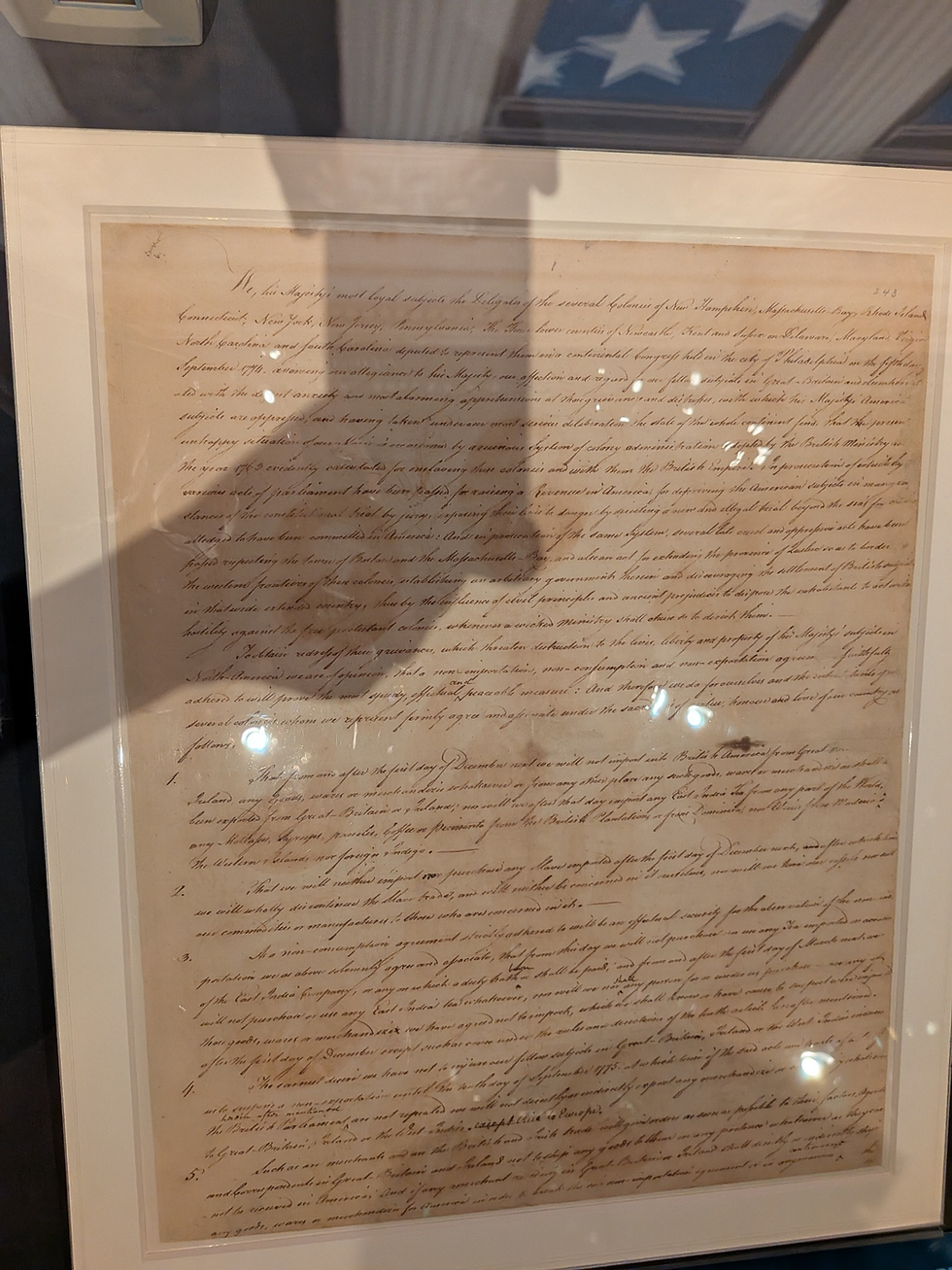
All photographs accompanying this article were taken by Rebecca Canales while visiting the National Archives’ Freedom Plane exhibition at USC in Los Angeles on April 17, 2026.
If you would like to know more about the Treaty of Paris and the recognition of American independence, you can get more information here:
National Archives — Treaty of Paris (1783)https://www.archives.gov/milestone-documents/treaty-of-paris-0
U.S. Department of State, Office of the Historian — Treaty of Parishttps://history.state.gov/milestones/1776-1783/treaty
Founders Online — Ratification of the Definitive Treaty of Peacehttps://founders.archives.gov/documents/Jefferson/01-06-02-0356


Comments