
The Constitution Is America's Bridge
On June 28, 2026, rain followed me through Washington, D.C., as I made my way from the Washington Monument toward the memorials honoring America's veterans, the Reflecting Pool and the Lincoln Memorial.
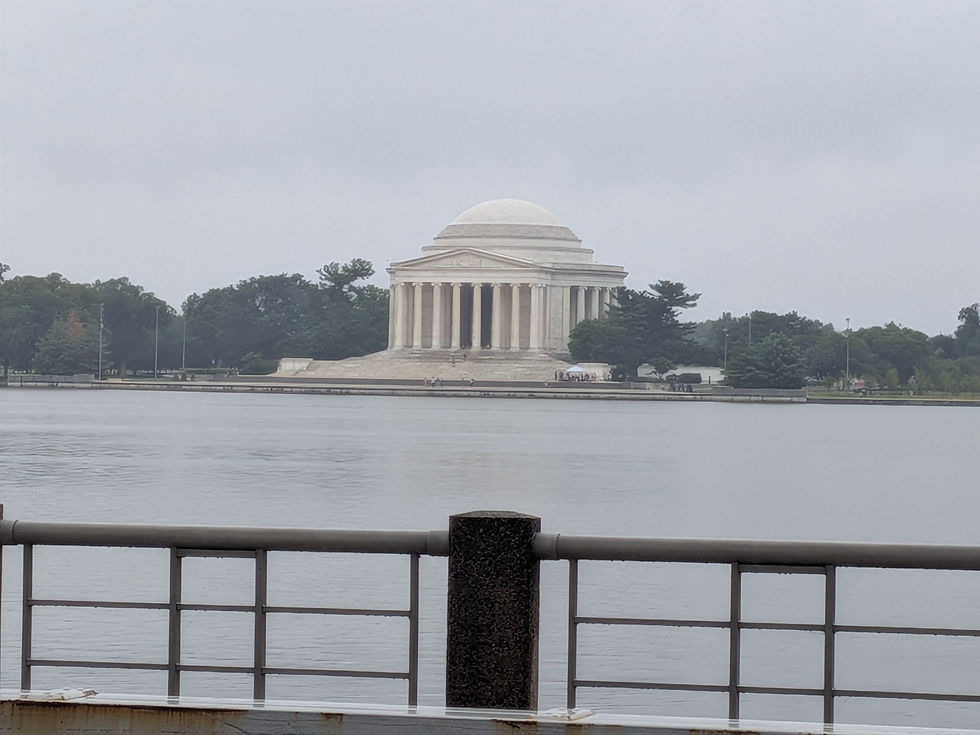
Across the Tidal Basin stood the Jefferson Memorial.
I had intended to visit Jefferson during the trip and at one point considered filming the Fourth of July fireworks from there. That visit never happened. On this particular afternoon, I was simply passing it on my way toward another part of Washington's monumental landscape.
But the photographs I took from the bridge captured something I did not fully appreciate at the time.
George Washington's monument stood in one direction. Thomas Jefferson's memorial stood across the water. Between them was a rain-soaked bridge beneath a dark and unsettled sky.

The image offers an appropriate metaphor for the United States at 250 years.
America remains deeply divided over politics, race, immigration, executive power, federalism, elections, guns, abortion, foreign policy, the role of government and even competing definitions of what the nation's founding principles require.
A bridge does not eliminate the divide beneath it.
It allows people on opposite sides to remain connected despite that divide.
For the United States, that bridge is the Constitution.
A Country Built Around Disagreement
Americans sometimes speak about national unity as though it requires broad political agreement.
The constitutional system suggests almost the opposite.
The framers constructed a government around the expectation that people, states, institutions and political factions would disagree.
The House and Senate can disagree with one another. Congress and the president can struggle over authority. States can challenge the federal government. Courts can invalidate actions taken by elected officials. Citizens are free to criticize all of them.
Elections allow political power to change hands without requiring the government itself to be overthrown.
The system is cumbersome precisely because it was not designed to make political victory absolute.
That helps explain why constitutional controversies become particularly important during periods of intense division. When Americans broadly agree, constitutional restraints are relatively easy to tolerate. The harder test arrives when government confronts war, perceived internal enemies, political extremism, unpopular speech or people whom a majority views with suspicion.
American history contains repeated examples.

America Has Been Here Before
Only seven years after ratification of the Bill of Rights, Congress enacted the Alien and Sedition Acts of 1798 as the United States moved toward possible war with France.
The Sedition Act made certain criticism of the federal government, Congress or the president a crime. According to the National Archives, the journalists prosecuted under it were editors of newspapers aligned with the opposition Democratic-Republicans. Newspaper editor Thomas Cooper was convicted after publishing material sharply critical of President John Adams.
The episode is significant because it occurred not generations after the founding, but during the political careers of the founding generation itself.
The First Amendment had barely been adopted before fear of foreign conflict and domestic opposition produced one of the country's first major confrontations over freedom of speech and the press.
Yet another component of the same 1798 legislation illustrates a different feature of the founding-era approach to governmental power.
The Alien Enemies Act remains federal law today.
The statute grants the president extraordinary authority over certain noncitizens in circumstances involving declared war, invasion or predatory incursion. But the law does not contain only grants of executive power. Its text also addresses protections surrounding that power.
For alien enemies who are not accused of actual hostility or another offense against public safety, the statute provides for time to recover, dispose of and remove their property and arrange their departure. In the absence of a controlling treaty, the president is directed to provide a reasonable period consistent with public safety and what the statute describes as “humanity and national hospitality.”
The law also contemplates judicial involvement in enforcement.
That history became unexpectedly relevant when President Donald Trump invoked the Alien Enemies Act in 2025 against Venezuelan nationals alleged to fall under his proclamation concerning Tren de Aragua.
The Supreme Court subsequently held that people targeted under the Act must receive notice sufficiently in advance to allow them to seek habeas corpus relief before removal.
That distinction is important to the broader constitutional debate.
The question is not simply whether government has power.
Governments necessarily possess power. Presidents possess power. Congress can grant extraordinary authority for extraordinary circumstances.
The constitutional question is what restraints accompany that power and whether those restraints continue to operate when government finds them inconvenient.
When Individual Process Disappears
World War II produced a much more severe example.
The Japanese attack on Pearl Harbor created a genuine national-security emergency. The United States had legitimate reasons to investigate espionage and sabotage and possessed legal authority for dealing with enemy nationals during wartime.
The central failure of the Japanese American incarceration was not the proposition that government could act against actual enemy agents.
It was the replacement of individualized evidence with collective suspicion.
President Franklin Roosevelt signed Executive Order 9066 in February 1942. The military subsequently removed people of Japanese ancestry from the West Coast without first determining individually whether they posed a security threat.
More than 120,000 Japanese Americans were incarcerated, approximately two-thirds of whom were U.S.-born citizens. The National Park Service notes that many were given only about a week to settle their affairs before removal.
American citizenship did not protect them from being swept into a program based primarily on ancestry.
That creates an instructive contrast with the Alien Enemies Act.
A statute directed toward actual nationals of an enemy country contemplated limits, process and time to deal with property. Decades later, American citizens could be uprooted without individualized findings that they had committed hostile acts.
The difference illustrates one of the recurring issues in American constitutional history: a legitimate governmental objective does not necessarily make every means used to achieve it legitimate.

The Press and the Problem of Who Decides
The same conflict between legitimate government interests and constitutional restraints appears in disputes involving journalism.
Government agencies can legitimately protect classified information, secure sensitive facilities, investigate crimes and control dangerous scenes.
But those powers can collide with the public's interest in independent reporting about government.
During the Obama administration, aggressive leak investigations generated national controversy after the Justice Department secretly obtained records involving Associated Press telephone lines and pursued records connected to Fox News reporter James Rosen.
Those controversies produced another debate that has become increasingly important as traditional newspapers have contracted and independent digital journalism has expanded:
Who counts as a journalist?
The question is particularly consequential for small and local news organizations.
While researching how to approach the Los Angeles County Sheriff's Department for information concerning a story, I encountered agency requirements that initially appeared oriented toward larger established news organizations. In private community discussions, I also encountered claims that law enforcement could simply determine which organizations or individuals deserved to be regarded as legitimate press and exclude those it did not recognize.
California law is broader than that proposition.
Penal Code §409.7 expressly recognizes representatives of an “online news service,” along with newspapers, news services, radio and television organizations, when establishing protections for journalists covering demonstrations, protests and similar First Amendment activity behind certain police closures.
That does not mean calling oneself a journalist creates an unlimited right to enter every secured location. It does not.
Law enforcement can enforce legitimate safety rules and restrict areas where unrestricted entry would interfere with operations or endanger people.
But regulating access to a particular place is different from giving government unrestricted authority to determine who belongs to “the press.”
That distinction matters as journalism changes.
A constitutional conception of press freedom that functionally depended upon employment by a large newspaper or television corporation would leave communities increasingly vulnerable as large local newsrooms disappear.
The Founders Were Not Saints — And That Is Not the Test
None of this requires treating the founding generation as morally infallible.
They were not.
Some owned enslaved people. Women lacked political equality. Native peoples would experience devastating policies as the new nation expanded. The founders disagreed sharply among themselves over government power, finance, foreign affairs, religion and the direction of the republic.
Those facts belong in the historical record.
But historical failures do not erase historical accomplishments.
Washington's slaveholding does not erase his command of the Continental Army, his role in the establishment of the presidency or the significance of his voluntarily relinquishing political power.
Jefferson's participation in slavery does not erase the historical importance of the Declaration of Independence and its assertion of natural rights and government by consent.
Madison's shortcomings do not erase his central role in the Constitution and Bill of Rights.
History becomes distorted when historical figures are transformed into saints.
It can also become distorted when they are reduced entirely to their failures.
For Americans today, a more consequential question is not whether eighteenth-century Americans perfectly fulfilled their own ideals. The historical evidence shows that they did not.
The question is what those ideals meant when they were adopted and what obligations they impose on later generations.
That question lies at the center of the modern legal debate over originalism.
In constitutional law, original-public-meaning originalism generally asks how constitutional language would have been understood by the public at the time of ratification rather than attempting simply to reconstruct the private intentions of individual founders. Congress's Constitution Annotated identifies District of Columbia v. Heller as an important example of that methodology.
The Supreme Court extended a text-and-history approach to Second Amendment regulation in New York State Rifle & Pistol Association v. Bruen.
But the Court subsequently clarified in United States v. Rahimi that historical analysis does not require locating an exact eighteenth-century duplicate of every modern law. A modern regulation may be consistent with the historical tradition when it is sufficiently analogous to what that tradition permitted.
That distinction has implications well beyond firearms.
The founding generation knew nothing of social media, electronic surveillance, artificial intelligence, nuclear weapons or the modern administrative state.
It did understand censorship, political faction, searches, warrants, executive power, judicial independence and due process.
Originalism remains contested among judges, lawyers and historians. But the debate raises a fundamental question relevant to America's 250th anniversary: whether constitutional principles should be interpreted by first attempting to understand their historical meaning, or whether changing social conditions permit broader reinterpretation.
The answer is not resolved simply by pointing to the founders' personal failures.
What Would the Founders Recognize?
Attempts to assign the founders wholesale to either modern political party are historically difficult to sustain.
They disagreed too much with one another.
If Washington, Jefferson, Madison, Adams, Franklin and their contemporaries could observe the United States in 2026, they would likely recognize themselves in portions of contemporary political debate.
Arguments about executive authority would be familiar.
So would disputes over federal versus state power, taxation, immigration, war, property, political faction and individual liberty.
Some present-day policies would probably look like descendants of arguments individual founders themselves made.
Others would likely be abhorrent to them.
Which founder objected to which policy would depend heavily upon the founder.
That is one reason the more useful comparison is between modern government and the constitutional principles the founding generation established rather than attempts to imagine how Jefferson or Washington would vote in a twenty-first-century election.
The recurring issues remain recognizable:
How much power should one president possess?
When does national security justify restrictions on liberty?
How should government reconcile immigration enforcement with due process?
How should election security coexist with access to lawful voting?
When does regulation protect the public, and when does it become excessive governmental control?
When does law enforcement maintain public order, and when does its response infringe speech or assembly?
And when government interacts with the press, where does legitimate control of access end and impermissible control over journalism begin?
Those disputes cross modern party lines.
Washington's Warning Was About More Than Parties

George Washington's Farewell Address is frequently summarized as a warning against political parties.
The document went considerably further.
Washington feared that sectional and partisan loyalties could become stronger than attachment to the Union itself. He warned that political organizations could become tools by which ambitious leaders accumulated power.
His description of partisan escalation was particularly stark.
Washington warned that alternating factional domination, intensified by revenge, could produce increasingly severe conflict. Eventually, he wrote, people exhausted by instability might seek security in the “absolute power of an individual,” allowing the leader of a prevailing faction to elevate himself on the ruins of public liberty.
He also warned that partisan passions could create openings for foreign influence and corruption, allowing the interests of another country to become entangled with America's domestic political divisions.
Washington did not argue that disagreement should disappear. Political parties were already emerging around him.
His concern was divided loyalty: the point at which Americans might value victory by their faction, region or political interest more highly than the survival and stability of the constitutional system itself.
Mount Vernon's historical summary of the address describes Washington's advice in straightforward terms: Americans should focus on what is best for the country rather than what is best for their political party.
That warning remains relevant because extreme partisanship changes the way constitutional behavior is judged.
Executive power can appear intolerable when exercised by an opposing president and necessary when exercised by one's own.
Restrictions on speech can appear dangerous when aimed at allies and reasonable when aimed at opponents.
Foreign influence can appear alarming or dismissible depending on which political faction it seems to benefit.
The constitutional rule, however, does not change simply because control of government changes hands.
The Monuments Remain During the Storm
The weather on June 28 provided another metaphor.
The road was soaked. The sky was gray. The monuments were sometimes softened by rain and atmospheric haze.
But they remained standing.
So has the United States through periods much darker than that Washington afternoon.
The country survived a Civil War that killed hundreds of thousands and placed the survival of the Union itself in doubt.
It survived the collapse of Reconstruction, Jim Crow, racial violence and recurring racial resentment.
It survived economic depression, world wars, political assassinations, terrorism, riots, corruption and constitutional crises.
It also survived ideological challenges from movements that promised political certainty through concentrated authority.
Fascism historically offered national rebirth and unity through authoritarian power on the extreme right. Totalitarian communist systems and other forms of authoritarian socialism promised revolutionary equality while concentrating political and economic authority on the extreme left.
Those ideologies are not interchangeable, and their histories differ substantially.
Their relevance to constitutional government lies elsewhere.
The danger appears when any political movement concludes that elections, independent courts, freedom of expression, due process, political opposition or limits on governmental authority are obstacles that can legitimately be removed because the movement's goals are sufficiently important.
That is the recurring authoritarian bargain: greater concentration of power in return for promised order, security, justice, equality or national restoration.
American history demonstrates both the country's vulnerability to such pressures and its capacity for correction.
Slavery was followed by constitutional abolition.
Jim Crow was eventually confronted by the civil-rights movement and federal civil-rights law.
Government attacks on political expression helped produce stronger legal protections for speech.
Wartime violations of civil liberties became warnings for later generations.
Those corrections often arrived far too late for the people who suffered the original injustice.
Progress has not been linear.
The United States has moved toward its stated principles, away from them and back toward them repeatedly.
Despite some of the worst and most divisive storms in its history, however, the nation still stands.
Like the monuments on June 28, it has sometimes been obscured and battered without disappearing.
The Constitution Is America's Bridge

That leaves the bridge.
A bridge is necessary only because a divide exists.
It does not fill the river beneath it. It does not make opposite shores identical. Its purpose is to maintain a connection across something that would otherwise separate them.
That is one way to understand the Constitution.
Americans do not share one religion, ideology, region, race, economic interest or political party.
They never have.
The Constitution provides a common political structure across those divisions.
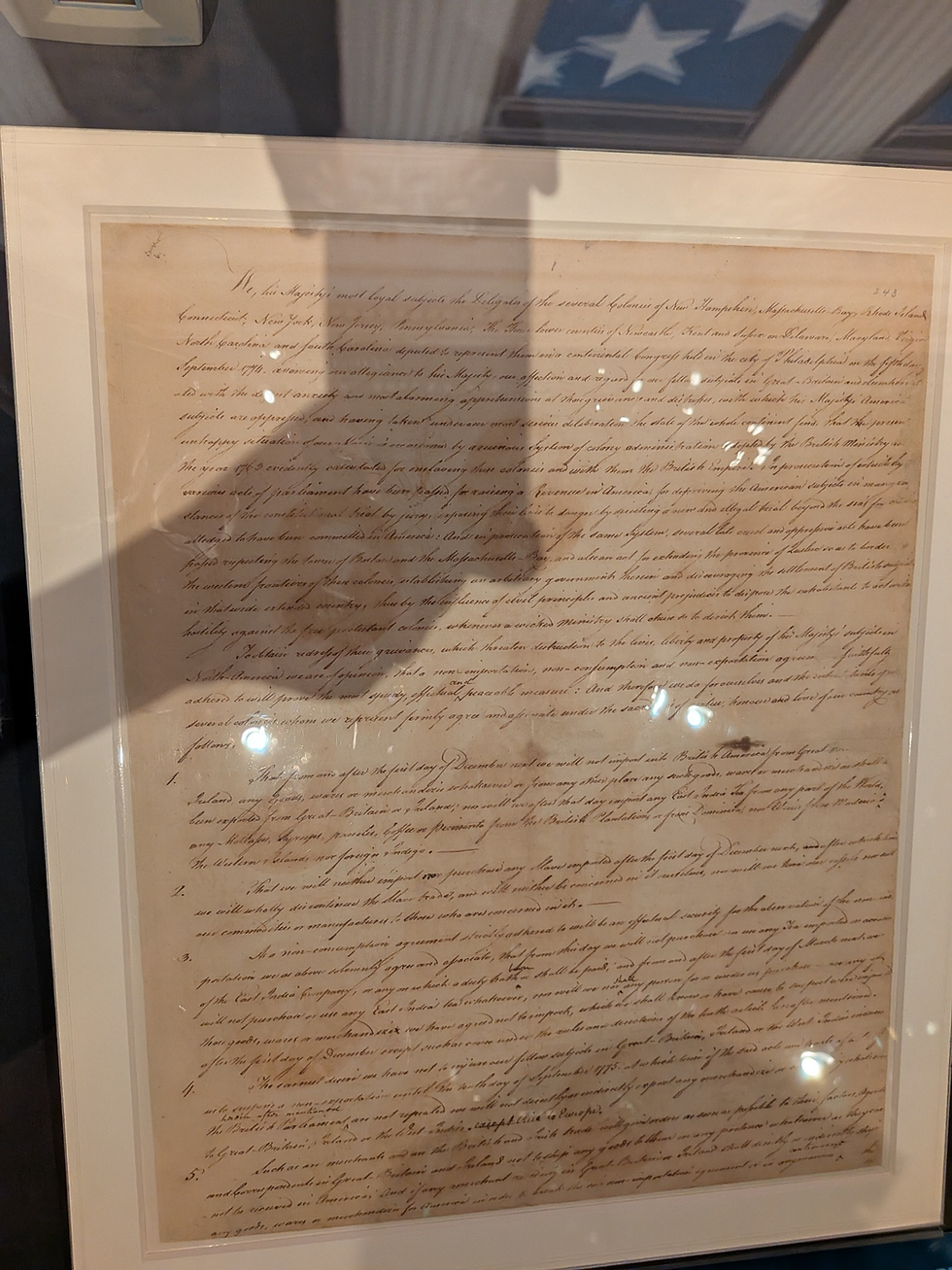
Its opening words—“We the People of the United States”—established a national constitutional framework, although the full meaning of political membership would be contested and expanded for generations.
The original Constitution tolerated slavery. Political rights were severely restricted by standards Americans would reject today.
But the constitutional system also contained mechanisms for alteration.
The Reconstruction Amendments abolished slavery, established national citizenship and constitutional protections, and prohibited racial discrimination in voting. Later amendments and legislation expanded political participation further.
The constitutional bridge of 2026 is therefore not identical to the one completed in 1787.
It has been rebuilt and expanded.
Yet its essential function remains recognizable.
Congress and the president can disagree without either ceasing to exist.
States and the federal government can litigate the boundaries of their power.
Citizens can remove elected officials without removing the Constitution.
A person whose candidate loses an election retains the same constitutional rights the next morning.
The First Amendment protects opposition speech.
Due process constrains what government can do to people it accuses.
Separation of powers makes it harder for any one institution to acquire complete authority.
Federalism distributes governmental power geographically.
Courts provide a forum in which executive and legislative actions can be challenged.
The amendment process makes constitutional change possible without requiring constitutional destruction.
These mechanisms do not guarantee national harmony.
They provide something more practical: a way for a divided country to remain one country.
That distinction becomes particularly important in periods of political polarization.
The Constitution is not designed to ensure that one faction always gets its preferred outcome.
Its restraints frequently frustrate whoever possesses power at a particular moment.
That frustration is part of the design.
A constitutional limit that binds only political opponents is not much of a constitutional limit.
A protection for speech that applies only to popular ideas offers little protection.
Due process matters precisely because government may be convinced that the person it has accused deserves punishment.
The constitutional structure requires Americans to continue sharing institutions even when they strongly disagree about what those institutions should do.
A Republic That Has to Be Maintained
The monuments around Washington can create an impression of permanence.
Stone survives longer than administrations, political movements and individual lives.
Constitutional government is different.
The document can remain physically intact while its restraints weaken in practice.
Institutions depend upon officials respecting powers they do not possess, courts retaining independence, election losers relinquishing office, winners accepting limits on their authority, journalists continuing to investigate government and citizens regarding political opposition as legitimate.
None of those habits is automatic.
They are political norms reinforced by law, precedent and repeated practice.
That may be where Washington's warnings, the Alien and Sedition Acts, Japanese American incarceration and modern disputes over executive authority and press freedom intersect.
The specific controversies are different.
The constitutional problem repeats.
Government encounters a threat.
Officials assert power.
The public must determine whether the asserted power is legitimate, whether statutory and constitutional safeguards remain operative and whether emergency conditions justify what government proposes to do.
Sometimes the government is right.
Sometimes its critics are right.
Sometimes courts intervene.
Sometimes history renders a harsher judgment years later.
The system was designed so that those arguments could occur without requiring the country to fracture each time they arise.

On June 28, I continued across the bridge.
Jefferson remained across the water.
Ahead were the memorials to Americans who fought in later wars and, eventually, Lincoln—a president whose generation confronted the greatest rupture in the constitutional Union.
That physical journey through Washington also traces something about American history.
The founding generation established principles it did not consistently fulfill.
Later generations inherited both those principles and the contradictions surrounding them.
Some expanded the meaning of American citizenship.
Others narrowed it.
Some strengthened constitutional protections.
Others violated them.
The country moved forward, backward and forward again.
At 250 years, the United States remains divided over what many of its founding principles require.
That disagreement is unlikely to disappear.
Perhaps it was never supposed to.
A bridge does not eliminate the divide running beneath it.
It prevents the divide from becoming an impassable separation.
The Constitution cannot make Americans agree.
Its more important task is allowing Americans who disagree profoundly to remain "We the People" anyway.
The monuments may symbolize the principles and people Americans remember.
The Constitution is the bridge that keeps the country connected to them—and to one another.


Comments